Torah Portion: What are the Tassles on the corners of my Clothes for ?

“You Shall Make Tassles on the Corners of your garments” (Deuteronomy 22:12)

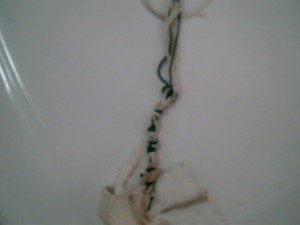
Twice this week I was asked by a traveller on one of my tours what the funny Tassels (one of which is pictured above) was for.

Its something that I forget when guiding is that some of the basic facts about Judaism are also interesting to someone visiting Israel for the first time.

The Commandment to Wear Tsitsit

Twice in the Bible (the source above and Numbers  / Bamidbar 15:37 -41) the Jewish people are commanded to put tassels on the corner of their garments. In the instance in the book of Badmidbar / Numbers the Jewish people are told to wear distinctive blue tassels made out of a die found in the blood of a certain snail. The Rabbis interpreted that this commandment was only applicable for men and only during the day.

What’s the Reason?

According to the section in Badmidbar / Numbers  the reason that Jews wear such tassels is to be constantly reminded about the commandments and not come to err.

Being a Moral Agent in one’s personal Deeds

The next verse is the start of a law concerning marital impropriety. The juxtaposition of these two concepts teaches that one could think that one wears Tsitsit in public so a person can be easily recognised as a religious Jew and then forced to behave in a proper manner due to social pressure. This time teaches that when only the individual himself can see his Tsitsit he is forced to act in a proper manner due to the  meaning he himself places  on these tassels.


Torah Portion Ekev: A Land of Light

Olive Trees, Haas Promenade

Olive Trees, Haas Promenade by YossiTourGuide

Olive trees on the Haas Promenade

“A Land of Wheat, of Barley, Grapes, Figs and Pomegranates, a land of  Olive Oil and honey” (Deuteronomy / Devarim  – 8:8)

This weeks portion of the Torah discusses some of the blessed qualities of the land of Israel.

There is a slight textual difficulty in that it only mentions one product of a fruit; Olives. It does not say a land of ‘Wheat Bread’ or ‘Grape wine’ or ‘Pomegranate slushies’.

What Are Olive Trees Good For ?

So one answer given by Rabbi Shlomo Yitzchaki (10th Century Torah commentator) is to tell us that the Olive trees were used for oil. But is n’t this a bit obvious; we can get 2 things from an olive tree:

1 Olives

2 Olive Oil.

Surely we could say that about all these fruits.

Ah! but all these other fruits have multiple uses: you can have beer or bread, pomegranites, pomegranite slushies or grenadine etc. With olives thats pretty much all you get; olives and oil. Ever heard of Olive wine ? Normally (unless we’re constipated) we do n’t drink Olive Oil. All these other products are edible as well.

Its all Part of the Process

Three of the fruits have a process associated with them. Both wheat and grapes can be fermented to make bread, beer or wine, by extension all of the fruits except for Olives can be fermented but that’s fairly uncommon, people mosly ferment wheat and grapes.

Olives have a special process associated with them. Firstly they are squashed normally releasing a tiny little bit of oil. This first squeezing releases the best oil or ‘Virgin Oil’. Then the pips and skins are gather again, put in baskets and squeezed once more. Since antiquity Olives have undergone this intricate process of squeezing.

This is for collecting the virgin Oil from the first crush, the upper stone is called a memel, the lower stone is called a 'yam.

This is a re -constructed ' beam and weight' press from Tel Hatzor, the baskets of olive bits are squashed by the Kora 'beam'' to collect the lower stage of Olive Oil.

Olives: Not just for Salad Dressing – a symbol of Light


Olive oil was the main source of lighting in the Ancient Near East, the purpose of the process mentioned above was light. The product of Olives – oil gets a special mention because of its high value.  My teacher, Rabbi Yitzchak Hirshfeld said that Olives are a symbol of the Jewish people that they are crushed through the travails of history and continue to produce the Light of Truth, the light of the Torah.


(These words of Torah are dedicated to the speedy recovery of Zlata bat Sima, please include her in your prayers and in the memory of the seven precious souls who were killed today in Southern Israel)

Torah Portion: Shelach

When I used to think of the word ‘Negev’, I would think of it meaning ‘South’ or ‘Desert’. I never used to think of it as being something that one ‘goes up to’. In fact from my vantage point in Jerusalem today, I very much descend in altitude to the Negev.

However if we look at the topographic map pictured above, we can clearly see (as indicated by the orange and red colours signifying altitude) that if I was coming from Paran, which is part of the central valley system (running down the centre of the map in green and blue signifying a lower area) I would certainly be rising in altitude. In fact the whole Negev system, which is the southern part of the map from Beersheva to the Jordan and Arava valley running down the middle, is a highland.

But this phrase is not just talking about a rise in altitude, but also a ride in spirituality. A rise in the spiritual depths of wandering the Desert to the heights of the Holy Land.  This phrase was also used by Ben Gurion in his attempts to settle the Negev, he told the people;

‘Go up to this Negev!’